
How to Design Personal Projects So You Can Build Your Own Thing
Why smart people get stuck between exploration and building.

There are two types of advice in the “build your thing” world, and both of them are keeping smart people stuck.
“Follow your curiosities and experiment,” say the internal discovery advocates who want you to create a more authentic life.
“Everyone has an offer inside them,” say the pragmatic coaches who can’t comprehend why some very capable people freeze at that sentence instead of feeling motivated.
These two pieces of advice are creating a trap: infinite exploration without building on one side, premature productization that gets abandoned before shipping on the other.
And in the meanwhile nothing tangible ever gets built.
There’s a missing rung between them. And it’s not what either camp is selling.
My Story
I took a career break ten months ago after seven years in corporate giants and UN humanitarian operations.
I started doing exactly what I’d dreamed about: I followed my curiosities with no constraints. I wrote frameworks on Substack and had fascinating conversations with awesome people. I even experimented: took my camera out and shipped almost one YouTube video per week for three months.
I felt deeply engaged.
But when I asked myself “What are you actually building?” the honest answer was: nothing.
For the first seven months, that didn’t bother me. Exploration was the whole point. I wanted to simply follow my curiosities and see where they took me.
But these last three months, I’ve wanted to build something tangible. Something rooted in all this self-knowledge I gathered, and that could actually be useful to others. Not even for an income yet, just to become someone who builds, solves problems, and ships.
It’s been the hardest journey of my life. It made me face all the ways I could hide before making myself vulnerable.
This essay is about the missing piece I had to build for myself to move forward. And the template I created to force myself to actually use it.
Why Both Pieces of Advice Fail
The Curiosity Trap
“Follow your curiosity” is great advice if you’re in identity crisis. If you’ve spent years climbing a ladder that doesn’t resonate anymore, listening to those whispers is essential. I needed this phase.
But I’ve come to a painful conclusion: curiosity without direction becomes intellectually pleasurable distraction. And nothing compounds meaningfully.
When you try to build something (especially when markets are involved), there’s automatic friction. Flow and curiosity aren’t enough to stay within that friction. We need attention anchors to stay with things when they’re not simply flowing.
Experiments help as attention anchors. If you ship three videos in three weeks, that sustains your attention even when it’s hard. But experiments don’t answer the most critical questions: Why are these being built? What problem are they solving? What’s at stake here? They just help you understand whether you like executing the action.
The advice itself isn’t wrong. It’s simply incomplete. We’re expecting too much from something that was meant to be an initiation step, not the entire mechanism by which something gets built.
The Offer Trap
“Just create your offer” is the coach-industrial-complex version. “Stop hiding and start selling.” “You’re ready, you just don’t believe it.”
I tried. I spent weeks trying to articulate “my offer.” Every time I got close, my nervous system would activate. Suddenly the offer needed “more research” or “wasn’t quite clear enough.”
I thought this was imposter syndrome or perfectionism. Here’s how I see it now: “Just create your offer” was asking me to run a marathon when I hadn’t walked around the block in years.
There’s a design skill gap at play here. In corporate environments, how you deliver value is pre-written into your role. Your job description defines the problem boundaries, the solution, what value means through KPIs. You just have to speak the corporate language. But when you’re building your own thing? You have to define the problem yourself, create the solution from scratch, determine what value even means, figure out who needs this, why they’d choose you, and how you’d deliver it.
As Jules Fedele mentions: “Corporate teaches you to describe yourself in titles, not capabilities. And when the title disappears, so does the vocabulary.”
This is a learnable skill, but only through action. Through trying to solve problems for specific people, talking to them and iterating. Through the messy process of continuously redefining value in collaboration rather than inheriting a definition.
So “just create your offer” isn’t just asking you to overcome fear. It’s asking you to perform a design skill you’ve never practiced, while also tolerating the nervous system activation of being seen and potentially wrong.
No wonder I kept stalling out.
I Had to Face It
I can write countless essays or publish hundreds of YouTube videos. But when I try to imagine organizing an online workshop or gathering? I blank out.
“This needs one more section.” “Let me refine the framework first.” “I need another ten years.”
Each time, it sounds reasonable. I believe my own explanations.
But the pattern is undeniable: every time an experiment requires real exposure, I discover it “wasn’t ready yet.”
“Follow your curiosity” let me research indefinitely. “Just create your offer” blocked me because if I didn’t have an offer, what could I do? Both modes kept me safely intellectual, endlessly refining, permanently preparing.
So I decided to treat this as the problem I was willing to solve. I designed a solution I could test on myself and share with others.
The missing rung between “follow your curiosity” and “build your offer.”
Personal projects.
Not side hustles. Not hobbies. Not “building in public.” Something else entirely.
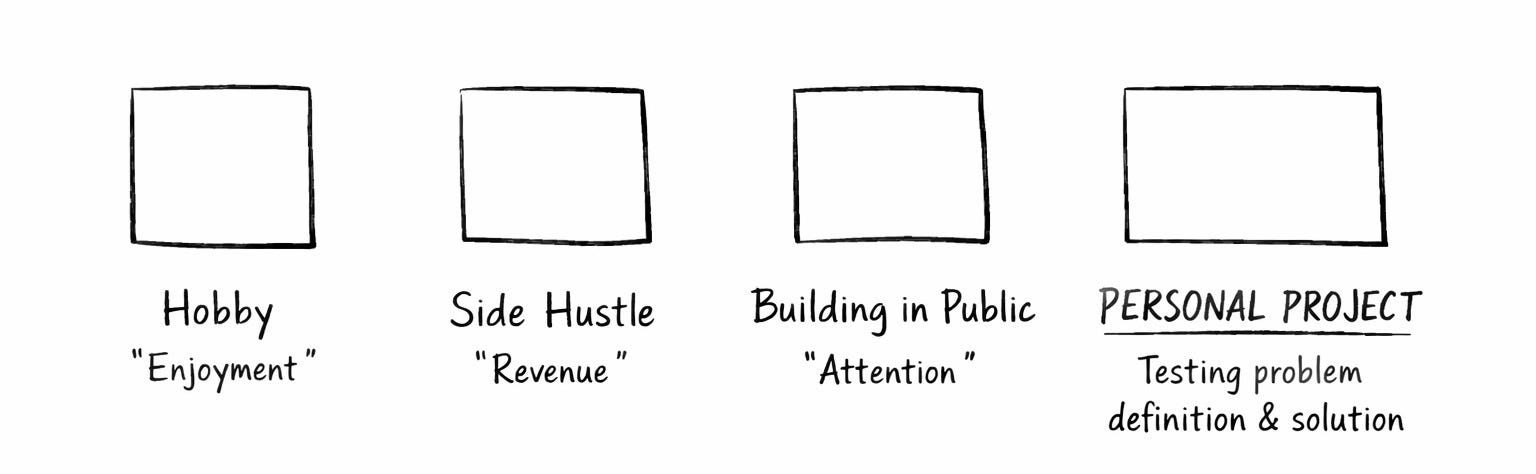
What Personal Projects Actually Are
A personal project solves a real problem for specific people in a constrained time. Small enough not to destroy you if it fails. Real enough to teach you something true.
They are not about what you are interested in, or good at (although rooted in them), they are mainly about a problem that exist out there, and people experiencing it.
The Formula:
“I will create [specific deliverable] for [specific number of people] to help with [specific problem].
Real examples:
“I’ll run 4 monthly dinners for 8 people questioning their careers and share the reflection”
“I’ll interview 15 people who left corporate jobs and publish a synthesis report”
“I’ll teach a 90-minute workshop on managing career transition anxiety for 10 colleagues”
What these are NOT:
“I’m going to start a podcast about career transitions” (no specific people, no deadline)
“I’m building a comprehensive framework” (no deliverable format, infinite scope)
A side hustle optimizes for revenue. A hobby is for private enjoyment. Building in public performs for abstract audiences. A personal project has stakes. It has consequences.
I call this “Consequence-First Design”: instead of asking “What do I want to explore?” you ask “What stakes I am ready to tackle to solve this problem for these people?”
Each project trains you to handle slightly more ambiguity, visibility, and risk. By the time you’re ready to “create your offer,” your nervous system has been conditioned for it.
Personal projects are basically exposure therapy. And when designed correctly, they make hiding visible .
The Potential Progression of a Career Transition
Curiosity → Experimentation → Personal Projects → Offers / New Role
(and bunch of self doubt, resignation and inspiration all together)
Curiosity explores what interests you. It is low stakes. Experimentation tests whether you like doing the thing. Personal projects test whether your understanding helps anyone else. Offers scale a form of help that’s already proven itself.
Personal projects are the bridge: the first place where your ideas stop being low stakes and start having actual consequences. That’s why they’re uncomfortable. That’s why I was avoiding designing them.
How to Build a Real Personal Project
Here’s the template I’m using these days to help me actually move.
Specific People Who Are Waiting. Not “the internet” or “people like me.” Real humans with names whom you can talk to to iterate while you define value continuously.
A Shipping Moment. The workshop runs, the report publishes, the prototype gets used. Answerable with yes or no only.
A Scope Kill Switch. List three or more things you’re tempted to add and then let them go. If they matter, they go in a future project. This is about protecting the project from your own perfectionism by drawing a hard line around what’s included.
Comfort Zone Expansion. Identify what specifically makes you uncomfortable: exposure, visibility, asking. That activation is information to see if you want to work on.
A Feedback Loop. The project isn’t complete until you receive feedback from real people. And that feedback can include confusion, disagreement, or indifference, and not just encouragement. And that is another skill we build, treating feedback as data.
Success redefined: You ship before you feel ready. You tolerate uncertainty without over-explaining. You practice real-world reaction.
The point is not forced productivity. It's scaffolding that helps you build skills and expand your comfort zone. It's nervous system training. You practise compassion with yourself, treat results as data, and treat design as a continuous process.
My Turn: Let’s Build Our Personal Projects Together
Here’s my personal project. Not a course on transitioning to self-employment. Not a comprehensive program (scope kill switch in action).
Simply: a space where we can share our journey and support each other in career transitions. We create and work on our personal projects together depending on where we are in our journey.
Inspired by Bhav Sharma & Becky Isjwara creator office hours, I’m starting Career Transition Office Hours where we reflect on our career transition journey, our projects, and set intentions to channel our attention.
If you’re in the messy middle between “I left” and “I know what I’m building”, if you recognize yourself in this pattern of productive hiding, reply and let me know.
What’s the personal project you’ve been circling but haven’t started?
The path forward might not be better ideas or more motivation. It’s learning to design projects that force the moment when your thinking leaves your head and touches reality. And it starts with one small project where specific people are waiting for something you’re slightly scared to ship.
This was mine. And your response will be my data and my feedback too.
I have created a personal project design notion template that makes avoidance impossible, you can reach it here. Let me know if it helps!
Don’t forget to sign up to Career Transition Office Hours: first one starting this Sunday.
Career Transition Office Hours
Every Sunday 9.30–10.30 PM Thailand / 5.30–6.30 PM EAT / 8.30–9.30 AM CT
Nice piece! I like the delineation between "side hustle" - > "personal project" and the others.
Great piece, Sinem! I think that process you describe is very valuable. And I still think the biggest transition is actually psychological, doing the inner work to loosen all the scripts we‘ve picked up that run the show for us if we don’t.